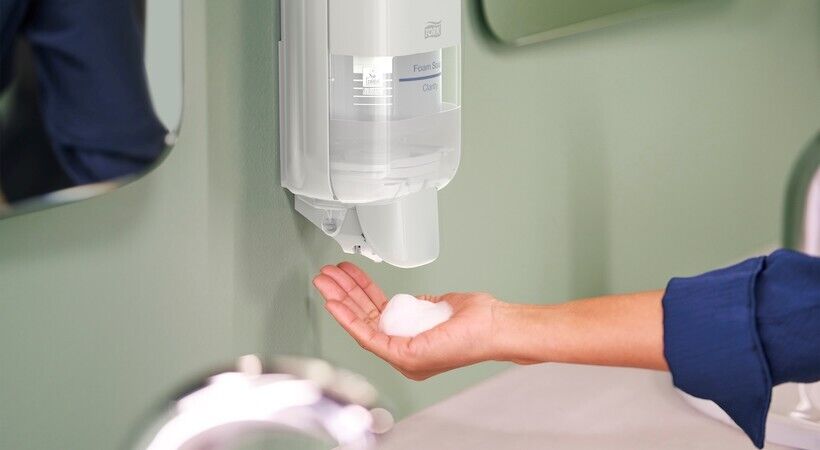
At a recent round table, experts and advocates agreed that a few simple changes could make washrooms more intuitive to use and easier to clean. Jeremy Bennett from Tork manufacturer Essity looks at the findings and offers solutions for making washrooms easier and more comfortable for users whatever their needs.
New Tork data shows that only one in five washrooms meet cleanliness expectations and over half of users take negative action after a poor experience – directly affecting businesses revenue and reputation.
Toilets are the busiest room in any public building. People use them in private and make physical contact with the architecture. And the Victorians understood this, designing public conveniences made from long-lasting materials that were imposing to look at while also being logical and easy to clean.
At the Tork European Roundtable on Inclusive Hygiene in Public Washrooms, experts from design, facilities management, public health and lived experience groups came together to identify the most critical improvements needed to remove invisible hygiene barriers faced by millions of people. The discussion reinforced a central principle: people are not the barrier – the environment is, and businesses have a clear opportunity to redesign washrooms to support comfortable access for as many users as possible.
They discussed the need to design for all users, not typical users. Suggestions for making washrooms easier to use such included the provision of lever handles or sensors for operating mixer taps and toilet flushes. Low force operation for dispensers, correct reach and placement of fixtures and predictable navigation help a broad range of users, including people with arthritis, skin sensitivities, neurodivergent users and those with hygiene concerns.
And ultra-white washrooms came in for criticism as delegates noted that these made it difficult for users to pick out dispensers from the wall. While acknowledging that white helped to create an impression of cleanliness, they felt the use of colour would provide a better contrast for people with visual impairments and those living with dementia.
Inconsistent interpretation of guidance leads to variable on site experiences. Participants called for minimum specifications for placement heights and operating forces and for simple guides to remove ambiguity.
Creating public washrooms that can be comfortably used by everyone should be an obvious requirement. However, the recent Tork study revealed that 54 per cent of people experience some form of difficulty when using a public washroom.
Individual conditions and circumstances can all make the use of a washroom either difficult or uncomfortable, according to the 2025 Tork Insight Survey which polled 11,500 people in 11 countries. Temporary factors such as a broken arm, a leg in plaster, a heavy suitcase or a small child in tow can also make standard facilities harder to navigate.
People with paruresis, or shy bladder syndrome, may also face invisible barriers to hygiene in washrooms where privacy is limited. And those who use catheters or ostomy bags may encounter challenges such as restricted space or lack of appropriate disposal options.
A degree of dexterity is often required to use the dispensers for soap, toilet paper and hand towels and this can cause difficulties for those with low hand strength or muscular or joint issues.
Wash hand basins tend to be situated at a uniform height which can be a problem for the very tall – who will be forced to stoop – and the very short who may not be able to reach them. And washrooms can also present a barrier for people with hygiene concerns or for those who feel uncomfortable in small, shared spaces.
Feeling anxious or uncomfortable when using a public washroom can have a number of negative effects. People may decide to avoid going out and participating in social activities, for example. It can prevent them from enjoying food and drink in public or generally feeling safe.
According to our survey, 73% of respondents said they felt unsafe when they were unable to wash their hands when out and about, while 38% claimed to avoid eating or drinking to reduce their risk of their needing to use a washroom.
Based on findings from the survey, Essity built an “unusable washroom” to demonstrate the invisible barriers that many people encounter. The company then videoed the public’s authentic reactions as they attempted to use it.
When faced with a standard soap dispenser a man with arthritis struggled with the force required to operate it, while an eczema sufferer found the abrasive hand towels supplied aggravated his skin. And an autistic child shared how the loud air dryer felt ‘like pins in the ears’.
These examples highlight how everyday design choices can create invisible barriers to hygiene, and why adapting environments accordingly is essential.
So, what can be done to remove barriers to washroom hygiene and ensure comfortable access to as many people as possible?
Easy-to-navigate entrances and automatic fixtures will make it easier to get in and out and to use the hand hygiene facilities. All dispensers should also be easy and intuitive to use, even for people with low hand strength.
Hand towel dispensers that give out towels automatically or that self-present will be easier to use than an over-stuffed unit. The towels themselves should be sufficiently soft and user-friendly to avoid aggravating any skin conditions. And noise levels on air dryers should be kept as low as possible to protect those sensitive to sound.
One key accessibility “must-have” - mentioned by 67% of respondents in the Tork Insight Survey - was that toilet paper should be housed in a dispenser from which it was easy to extract the tissue. Folded toilet tissue sheets or units that require the paper to be pulled out from the front require less dexterity than a jumbo roll where the user may struggle to find the end of the roll inside, for example.
The Tork SmartOne toilet paper dispenser gives out paper from the front of the unit and the tissue is protected before use to prevent product contamination or spoilage. Its design also enables users to take a sheet easily with one hand.
Awareness of the need to accommodate a wide range of requirements has grown significantly in recent years and an increasing number of Changing Places facilities are being included in public washrooms. While these remain essential, our research shows that only 5% of people with physical or cognitive conditions use wheelchairs.
Today’s washrooms should therefore follow a universal design approach, making them usable for as many people as possible to use - whatever their individual needs.
https://www.tork.co.uk
Usable washrooms – by design
Published 15th May, 2026 by Neil Nixon