
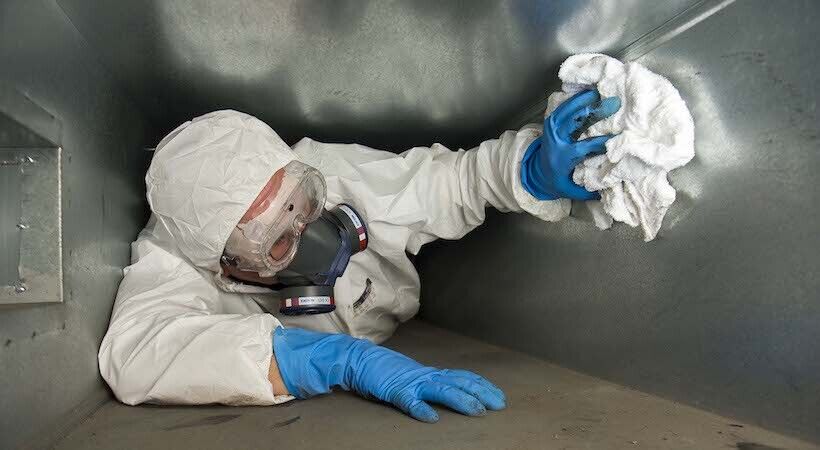
A year on from the publication of TR19 Air, Gary Nicholls, MD of duct cleaning experts Swiftclean, and co-author of this new specification, looks at the difference it has made.
TR19 Air – hailed as a revolution in indoor air quality – has helped to raise awareness of the need for ventilation hygiene; providing a new specification with which to comply, and encouraging wider adoption of best practice by facilities and cleaning managers.
It is the culmination of many years work by the BESA (Building Engineering Services Association), supported by industry professionals. Prior to 1998, ductwork hygiene expertise rested mostly with a group of specialist cleaning providers, who were formed into a steering group by the then HVCA. Their accumulated knowledge was first published as document TR17, which rapidly became the leading industry guidance for ductwork hygiene, for both ventilation and kitchen extract systems.

Over the years, this document was expanded and revised by its co-authors, all industry professionals. The first edition of TR19 was published in 2005; followed in 2014 by a second edition, which referenced new British and European Standard BS EN 15780 Cleanliness of Ventilation Systems which had been introduced in 2011.
However, it became apparent that ventilation system ductwork and kitchen extract ductwork each needed their own specification. In 2019, the first part of this was achieved with the issuing of TR19 Grease, published by the BESA as a new standalone specification for kitchen extract fire safety cleaning. This undoubtedly helped to raise awareness of kitchen extract cleaning as a critical fire prevention measure.
Due to a number of factors, not least the global pandemic, and the introduction of the Building Safety Act 2022, it was not until April 2024 that publication of sister document TR19 Air was completed.
With both TR19 Air and TR19 Grease now published, facilities managers and cleaning managers have two clear and robust specifications with which they must comply. Each contains helpful tables which provide accurate guidance on when and how often each ductwork system should be cleaned, making it simpler for managers to prioritise and schedule specialist cleaning tasks, and to achieve and maintain essential compliances.
In the light of the 2022 Building safety Act, it is encouraging that TR19 Air contains specific advice that access should be provided for the inspection, testing and maintenance of fire dampers inside the ventilation system. Fire dampers help to delay or prevent the spread of smoke and flames through ductwork.
Cleaning of ductwork systems in accordance with TR19 Air should also be certified, providing proof of each ductwork system’s compliance, and protecting the property’s Responsible Person from accusations of, and potential prosecution for, negligence.
This certification, which includes before and after cleaning photography, can only be issued by members of the Vent Hygiene Register (VHR), which is run by BESCA, the certification arm of the BESA. VHR members must use only competent technicians who hold BESA training qualifications in ventilation system hygiene. The advent of TR19 Air has also acted as a spur to increased formalised training and higher levels of certified skill among specialist ventilation cleaners.
Thanks to this new specification, we can all breathe a little more easily.
www.swiftclean.co.uk