Brodie Cook, Account Manager at Able Cleaning and Hygiene, working with care providers on cleaning systems, infection control practices and operational hygiene standards, reports.
Infection prevention in care environments is usually discussed in clinical terms: hand hygiene, isolation procedures and resident care practices. Those measures are fundamental.
Less attention is often given to the everyday systems that support cleaning itself.
In practice, environmental hygiene in care settings depends just as much on operational discipline as it does on clinical protocols. Cleaning products must be used correctly, equipment must be handled consistently and teams need clear procedures to follow across multiple shifts.
Where those systems work well, hygiene standards tend to be reliable and predictable. Where they do not, even diligent staff can struggle to maintain consistent results.
For facilities teams, this makes the design of cleaning systems an important part of infection prevention.
Cleaning as an operational system
Cleaning in a care home is not simply a series of tasks completed during a shift. It is a structured system involving products, equipment, procedures and training.
When those elements are aligned, they support consistent hygiene standards throughout the building. When they are not, variation quickly appears.
A common example is chemical use. Care environments often require a range of cleaning products designed for different surfaces and levels of contamination. If staff are uncertain about dilution rates or product selection, surfaces may be cleaned without being properly disinfected.
The opposite problem can also occur. Over-concentrated chemicals may damage surfaces or create unnecessary exposure risks for staff and residents.
Clear guidance on product use, supported by dosing systems or colour-coded labelling, can help reduce this variation and ensure chemicals are used consistently.
Organisation of cleaning materials
The organisation of cleaning materials has a direct impact on how reliably procedures are followed.
In many care homes, equipment moves constantly between areas as teams respond to daily demands. If products and tools are not stored systematically, staff may reach for whatever is available rather than the correct equipment for the task.
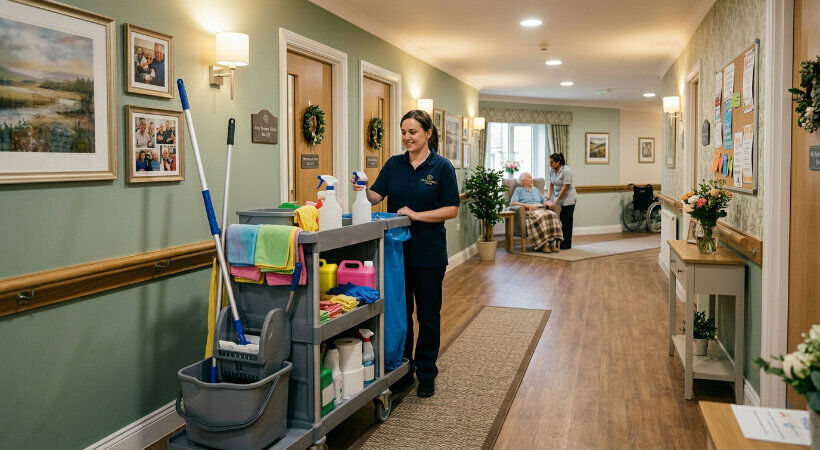
Colour-coded cleaning systems are widely used to prevent cross-contamination between locations such as bathrooms, kitchens and general areas. However, these systems only work when equipment is clearly separated and easy to identify.
When cloths, mop heads or cleaning solutions are stored together without clear labelling, the separation between areas quickly breaks down.
Well-organised cleaning cupboards and clear storage arrangements make it easier for teams to follow the intended system, particularly during busy periods.
Too many products, too much complexity
Another issue seen in many care environments is the gradual build-up of cleaning products.
Over time, facilities may accumulate multiple chemicals performing similar roles. This can happen through supplier changes, procurement cycles or simply through well-intentioned attempts to solve specific cleaning problems. The result is often a system that is harder to manage than it needs to be.
When staff are presented with too many options, consistency becomes difficult. Simplifying the range of products used across a site can make procedures easier to understand and follow.
In many cases, fewer products — used correctly — deliver more reliable outcomes than a large and complicated inventory.
Consistency across shifts
Care homes operate around the clock, which means cleaning responsibilities are shared between multiple staff members across different shifts.
Without clearly defined procedures, routines can gradually diverge. One team may clean an area in a particular way, while another approaches the same task slightly differently.
Individually these variations may seem minor, but over time they can create uncertainty about which tasks are being completed and how frequently.
Structured cleaning schedules help maintain consistency. When responsibilities are clearly documented and visible, teams can confirm that routine cleaning has been completed and identify areas requiring additional attention.
These schedules also make it easier for managers to review whether cleaning routines still reflect the needs of the building.
Cleaning equipment and hygiene risk
Cleaning tools themselves can become a source of contamination if they are not managed properly.
Reusable cloths and mop heads must be washed or replaced regularly. Equipment that remains damp for long periods can harbour bacteria rather than remove it.
This is particularly important where microfibre cloths are used extensively. Microfibre performs well when maintained correctly, but poorly maintained cloths can spread contamination between surfaces.
Treating cleaning equipment as part of the hygiene system — rather than as disposable tools — helps ensure that it continues to support infection control efforts.
The overlooked role of laundry processes
Behind many cleaning systems sits another process that receives less attention: the laundering of cleaning textiles.
Cloths and mop heads are often washed alongside other items unless clear procedures are in place. If washing temperatures are too low or loads are mixed incorrectly, microorganisms may survive the process.
This creates a cycle where contaminated materials are returned to circulation.
Separating cleaning textiles from general laundry and maintaining correct wash parameters helps prevent this issue. While this part of the system is rarely visible to residents or visitors, it plays an important role in maintaining hygiene standards.
Layout and workflow
The physical layout of a building can also influence how effectively cleaning systems operate.
In some facilities, cleaning cupboards or storage areas are located far from the spaces where they are most frequently needed. Staff may need to travel long distances to access equipment or refill chemicals.
When supplies are difficult to access, teams are more likely to improvise with whatever materials are nearby.
Reviewing cleaning workflows and ensuring that supplies are positioned conveniently can help support consistent procedures. Sometimes relatively small changes to storage locations can improve efficiency and reduce the temptation to bypass established systems.
Training and communication
Even the best designed systems depend on people understanding how to use them.
Staff need clear guidance on product use, equipment allocation and the reasoning behind colour-coded systems. Without this context, procedures can appear arbitrary and are less likely to be followed consistently.
Training programmes help ensure that new staff understand the structure of the cleaning system from the outset. Refresher training can also be useful when procedures change or when new equipment is introduced.
Visual reminders — such as colour-coding charts or product guidance — often help reinforce these systems in day-to-day practice.
Small operational gaps
Infection control challenges in care environments rarely arise from dramatic failures. More often they develop through small operational gaps: a cloth used in the wrong area, a chemical diluted incorrectly or a routine that gradually slips out of alignment.
Individually these issues may appear minor. Repeated over time, however, they can undermine otherwise effective hygiene practices.
Reviewing cleaning systems periodically helps identify these small inconsistencies before they accumulate into larger risks.
Environmental hygiene as part of care
Care homes depend on a combination of clinical practice and environmental management to maintain safe settings for residents and staff.
Cleaning systems sit at the centre of that environment. When products, equipment and procedures are aligned, they provide the structure that allows staff to maintain consistent hygiene standards.
Infection prevention is therefore not only about the cleaning tasks themselves, but about the systems that support those tasks every day.
https://welcometoable.co.uk/
Managing infection risk through cleaning systems in care environments
Published 3rd July, 2026 by Neil Nixon