
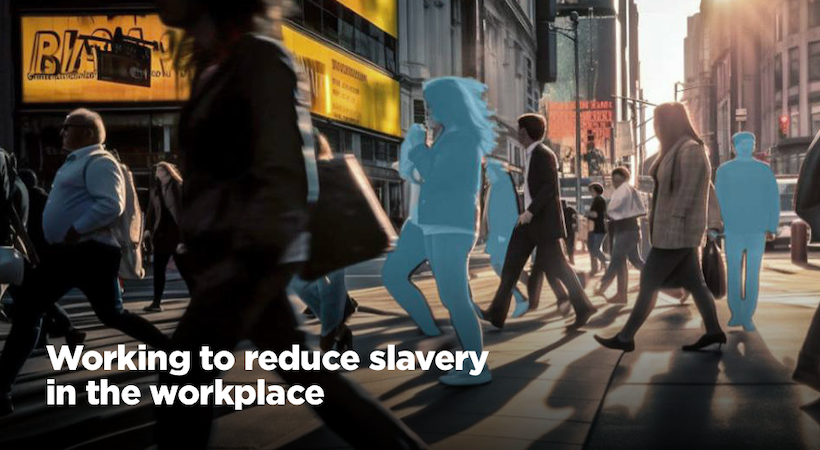
Callum MacLeod, Managing Director of Stamp Out Slavery, reports.
It’s rare for the two main political parties to come together for a common purpose and rarer still when that purpose is related to the rights of the individual.
The Modern Slavery Act 2015 (MSA) probably enjoyed broad political support because it was one of those rare examples where the law steps in to protect individuals from exploitation, protect businesses from unfair competition based on that exploitation and deliver the mechanisms to identify and prosecute people involved in serious organised crime. No losers and no one disadvantaged except the people making millions on the misery of others.
That’s not strictly true of the implementation of Labour’s Fair Work Agency (FWA) which rolled into operation on 7 April 2026. There are similarities; the FWA is primarily concerned with exploitation and violation of workers but goes further. There are new powers, for example, which allow the FWA to bring a claim to an Employment Tribunal if the employee decides not to. This is legislation entirely in tune with Labour’s history of strengthening rights for workers with any number of statutes, examples from the many including the Minimum Wage Act 1998, Employment Relations Act 1999 and Employment Act 2002. The Agency is not lightning from a blue sky.
But it wasn’t Labour’s idea.
The Conservatives commissioned Matthew Taylor to write his Taylor Review of Modern Working Practices in 2017 and had their Good Work Plan reforms ready to roll out into legislation from 2018, the 2020 turmoil preventing it going ahead. Labour picked up the ball and have installed Matthew Taylor at the head of this agency which combines and replaces most of the other enforcement agencies.
The FWA is an entity dedicated to the identification and prosecution of companies who exploit their labour. Facilities management is an industry which is labour intensive and which is often perceived as low margin, and therefore higher risk.
Among others, Focus on Labour Exploitation (FLEX), Unseen and the TUC have repeatedly drawn wider attention to abuses identified within cleaning and while it would reasonably be argued from those of us within the FM industry that such abuses are not widespread, it can hardly be denied that they’re particularly unusual.
The first order of the FWA will be demonstrating, for the purpose of budget and political capital, their increased efficiency as a result of departmental integration. FM companies, as well as similar high risk sectors, are certain to attract particular interest in this first year of operation.
It’s impossible for the FWA, even with a budget 25 per cent greater than the previous agencies combined, to inspect more than a few thousand businesses from the around 5.5 million in the UK so the odds are, even in our unquestionably target sector, that comparatively few businesses will be inspected.
The odds have substantially increased, though; and so have the powers and the penalties. The FWA is nowhere near as effective as it could have been if it had, as Professors Ruth Dukes and David Whyte point out in the Fair Work Agency Briefing, incorporated the HSE and unions into overall reporting mechanisms. The failure to do so leaves gaps although that is not to say that these could not be addressed in future legislation. The agency has been created and evidence of success will strengthen calls for expansion.
For FM, then, there’s an unequivocal message. The rules have changed and the oversight has increased. If your processes aren’t robust, you’re not definitely going to be inspected. But the chances of your being inspected have definitely increased and the consequences of failing an inspection have become much heavier. Labour enforcement isn’t peripheral, if it ever was. It’s central and operational.
https://www.stampoutslavery.org/
About the contributor

Callum MacLeod
Managing Director
Stamp Out Slavery